Amie Project
Amie Project
High-grade epithermal gold system with extensive historical development and independent technical validation
Amie Overview
- 106.8 g/t Au and 1,875 g/t Ag from recent surface sampling
- Historic production from shallow oxide zone; depth potential remains untested
- 11 adits, 4 shafts, 46 test pits along 2km+ mineralised corridor
- Recent field work highlighted in NI 43-101 Technical Report confirms epithermal signature and validates high-grade samples
Exploration History & Geological Setting
- Historic production from at least 11 adits, 4 shafts, and 46 test pits (1800s through WWII)
- Fully permitted and drill ready epithermal gold and silver opportunity
- Recent sampling at flagship Amie project returned 106.8 g/t Au and 1,875 g/t Ag, validated by a 2024 NI 43-101 Technical Report
- Early-stage geological modelling and surface sampling suggest the potential for a significant gold system
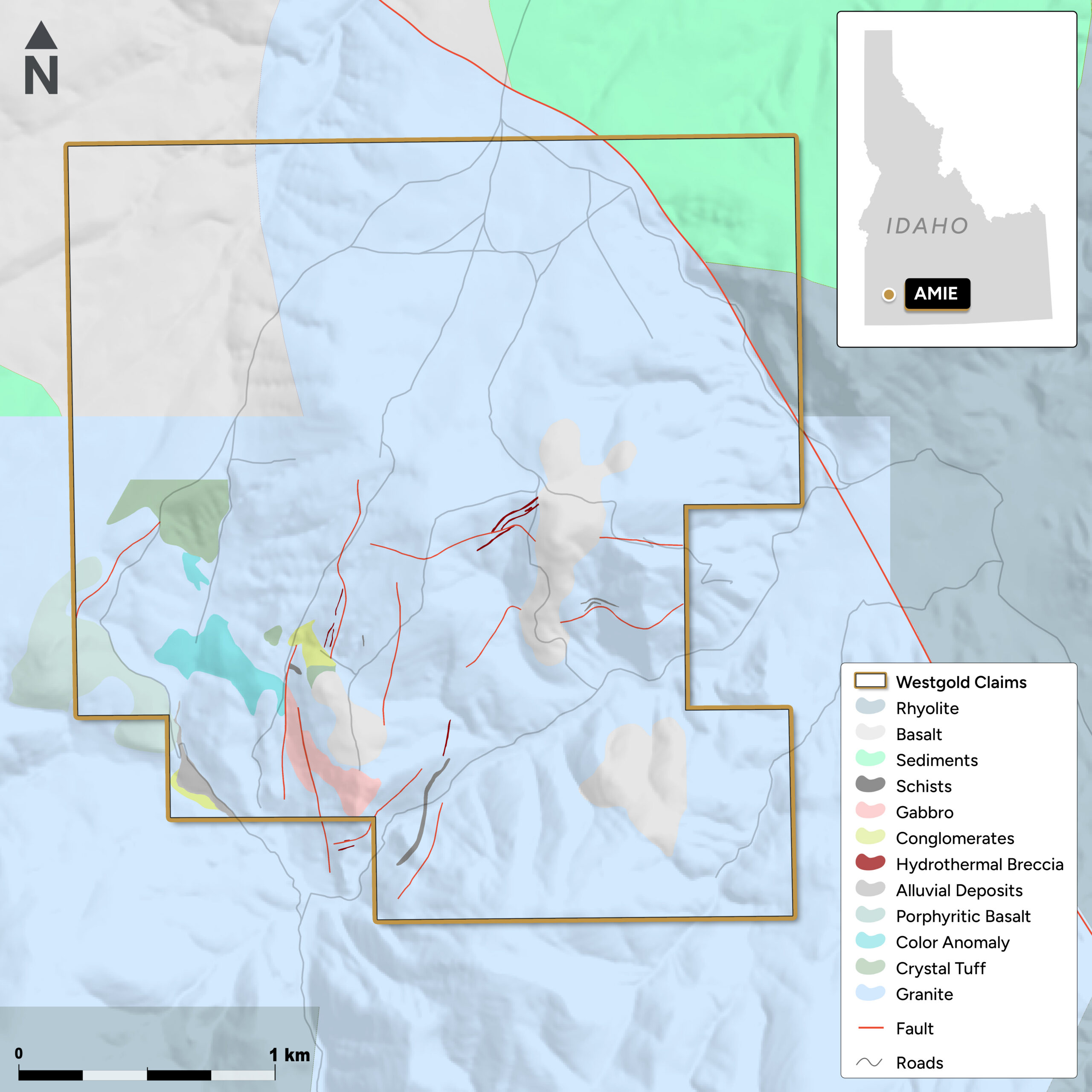
Amie: Geology and Targets
- Surface sampling returned multiple high-grade gold and silver results across the 2km+ mineralised corridor:
- 106.8 g/t Au and 258 g/t Ag (Big Shot Mine area)106.8 g/t Au and 258 g/t Ag (Big Shot Mine area)
- 16.1 g/t Au and 109 g/t Ag (Amie mine areas)16.1 g/t Au and 109 g/t Ag (Amie mine areas)
- 11.05 g/t Au (northwestern area)11.05 g/t Au (northwestern area)
- 4.04 g/t Au and 1875 g/t Ag (southern area)
- 106.8 g/t Au and 258 g/t Ag (Big Shot Mine area)106.8 g/t Au and 258 g/t Ag (Big Shot Mine area)
- Surface sampling returned multiple high-grade gold and silver results across the 2km+ mineralised corridor:
- Multiple fault orientations indicate structural complexity
- Mineralisation hosted in veins and hydrothermal breccias, hosted in a granitoid intrusion intercalated with lenses of schists
- Maiden drilling (2026) to test depth extensions of high-grade surface mineralisation